Connected car and vehicle data 19
What does a connected car consultant do?
I support companies in building and operating platforms that process data from connected vehicles. This includes requirements, the selection of data providers, data protection and the collaboration between business and engineering.
What experience does Marcus Braun have with connected car?
I have been working with vehicle data for more than twelve years. At ÖAMTC I built the connected car product Smart Connect, which received the FIA Innovation Award. Since 2020 I have been working as Team Lead Backend and consultant for connected cars on the connected car backend of ADAC.
What is the difference between dongle data and data directly from the manufacturer?
A dongle is a device that is plugged into the vehicle and transmits data itself. With manufacturer data, the information comes from the connected vehicle via the manufacturer's systems. The two approaches differ in data scope, timeliness, cost and in how the vehicle owner's consent is obtained.
Who is vehicle data relevant for?
For automobile clubs, roadside assistance, workshops, fleet operators and insurers. Typical applications are roadside assistance with vehicle diagnostics, maintenance notifications and fleet overviews.
Does Marcus Braun help with selecting vehicle data providers?
Yes. I know the offerings of manufacturers and data platforms from ongoing projects and help to assess them for a specific use case.
What was ÖAMTC Smart Connect?
Smart Connect was ÖAMTC's first connected car product. I developed it and brought it to market. The project received the FIA Innovation Award.
Does Marcus Braun have experience with international cooperation in the connected car field?
Yes. I was involved in founding the joint venture Intelematics Europe, which developed connected car solutions for European automobile clubs.
What is a connected car?
Connected cars are vehicles that are connected to the internet via mobile networks and exchange data, for example mileage, position, charge level or fault messages. This enables services such as roadside assistance with remote diagnostics, maintenance notifications or fleet management.
What is telematics?
Telematics combines telecommunications and informatics. In a vehicle this means: data is collected, transmitted and analysed, for example for positioning, logbooks, diagnostics or insurance tariffs.
What data does a connected vehicle provide?
Typical data includes mileage, fuel or charge level, position, warning lights, fault codes, tyre pressure and maintenance information. Which data is actually available depends on manufacturer, model and year of manufacture.
What is a diagnostic trouble code (DTC)?
DTC stands for diagnostic trouble code. Control units in the vehicle store such codes when they detect a fault. They are an important basis for remote diagnostics and roadside assistance.
What is the OBD interface?
OBD stands for on-board diagnostics. Diagnostic data can be read via the standardised OBD-II port in the vehicle. Retrofit devices for connected services are usually plugged in there.
What is a connected car backend?
The backend is the platform in the background. It receives vehicle data, checks consents, stores and processes the data and makes it available to apps, analytics and services.
What is First Time Right in roadside assistance?
First Time Right means that the right help arrives the first time. In the event of a breakdown, diagnostic data from the connected vehicle is analysed to assess whether a repair on site is possible or the vehicle has to be towed. I work on this project at ADAC.
How does artificial intelligence help in roadside assistance?
Machine learning models assess fault codes, warning lights and the description of the breakdown and give roadside assistance a recommendation. The decision is still made by a human.
Do I need the vehicle owner's consent to use vehicle data?
Yes. Vehicle data is generally personal data. Retrieving it requires the owner's consent, and the process for obtaining it differs from manufacturer to manufacturer.
How do you start a connected car project?
With a clear use case, an assessment of which data is needed and available for it, and a small pilot. Only then is it worth expanding to a platform.
What does access to vehicle data cost?
That depends on manufacturer, data scope and retrieval frequency. I help to estimate the cost for a specific use case realistically.
What is fleet management with vehicle data?
Fleet operators use vehicle data to keep an eye on locations, utilisation, maintenance needs and driving behaviour and to reduce costs.
EU Data Act 13
What is the EU Data Act?
The EU Data Act is Regulation (EU) 2023/2854. It gives users of connected products the right to the data generated by their use. It has been applicable since 12 September 2025.
Which vehicle data am I entitled to under the Data Act?
As a driver you have the right to receive your vehicle's data free of charge and in machine-readable form, and where technically feasible continuously and in real time. This is set out in Article 4 of the regulation.
Can I have my vehicle data passed on to a workshop or another provider?
Yes. Under Article 5 you can demand that the data goes directly to a third party of your choice, for example your workshop.
What else has applied since 12 September 2026?
Since 12 September 2026, new connected products must be built so that data access works from the start.
Are calculated values also covered by the Data Act?
No. The right applies to the data generated during operation. Information that a manufacturer derives from it with its own complex algorithms is not covered, according to Recital 15.
Who enforces the Data Act in Germany?
In Germany, the Federal Network Agency (Bundesnetzagentur) has been responsible since the end of May 2026.
What does data access look like in practice at the car manufacturers?
Most major manufacturers now offer a portal for customers. Companies that want to obtain data continuously via an interface face lengthy negotiations and high costs with some of them. You will find a comparison of eight manufacturers in my blog series “Ein Jahr EU Data Act” (in German).
Where can I find the series on the EU Data Act?
In the blog under “Ein Jahr EU Data Act”. The series has eight parts, is written in German and was first published on LinkedIn.
Who does the EU Data Act apply to?
To manufacturers of connected products and providers of related services in the EU, to users of these products and to third parties who receive the data. Cars are a prominent example, but the regulation applies to all connected products.
What is the difference between the Data Act and the GDPR?
The GDPR protects personal data. The Data Act governs access to data generated by connected products and applies alongside the GDPR. For personal data, the rules of the GDPR remain in force.
What does the Data Act mean for workshops and fleets?
They can demand access to vehicle data on behalf of their customers. In practice, much depends on which interfaces the manufacturers offer and on what terms.
What does the Data Act mean for companies that manufacture connected products?
They must give users access to the data generated and design new products so that this access is possible from the start.
Does Marcus Braun advise on the EU Data Act?
I am not a lawyer. I put into context what the Data Act means in practice for projects with vehicle data, which access routes the manufacturers offer and how a project can be built on them.
Artificial intelligence in business 24
How does Marcus Braun support companies in using AI?
With consulting, workshops and talks. Using examples from my daily project work, I show where AI helps reliably today and where its limits are, and I support teams with their first applications of their own.
How do you introduce AI in a team?
It has proven effective to start with concrete tasks from everyday work, share experiences within the team and derive rules for quality and data protection from them. We work out the right path for your company together.
What is agentic engineering?
Agentic engineering means developing software with AI agents that work on tasks independently in several steps. The human sets the requirements, checks the results and bears the responsibility.
Does AI replace software developers?
No. AI speeds up prototypes and routine work. Large, stable systems still need experienced development teams, architecture and testing.
Which AI tools does Marcus Braun work with?
I work with Claude and Claude Code every day, build my own skills and agent workflows and check the results against data and sources.
Can AI be used in compliance with data protection law?
Yes, if it is clearly defined which data goes into which systems. In my own projects I pay attention to self-hosted solutions and GDPR compliance, and I bring this experience into my consulting.
What does the Stanford AI Index 2026 show?
The report measures the state of AI every year in research, the economy, regulation and public opinion. I have put it into context for companies in the German-speaking region in 25 posts and a dossier. Both are available in the blog (in German).
What is WebMCP?
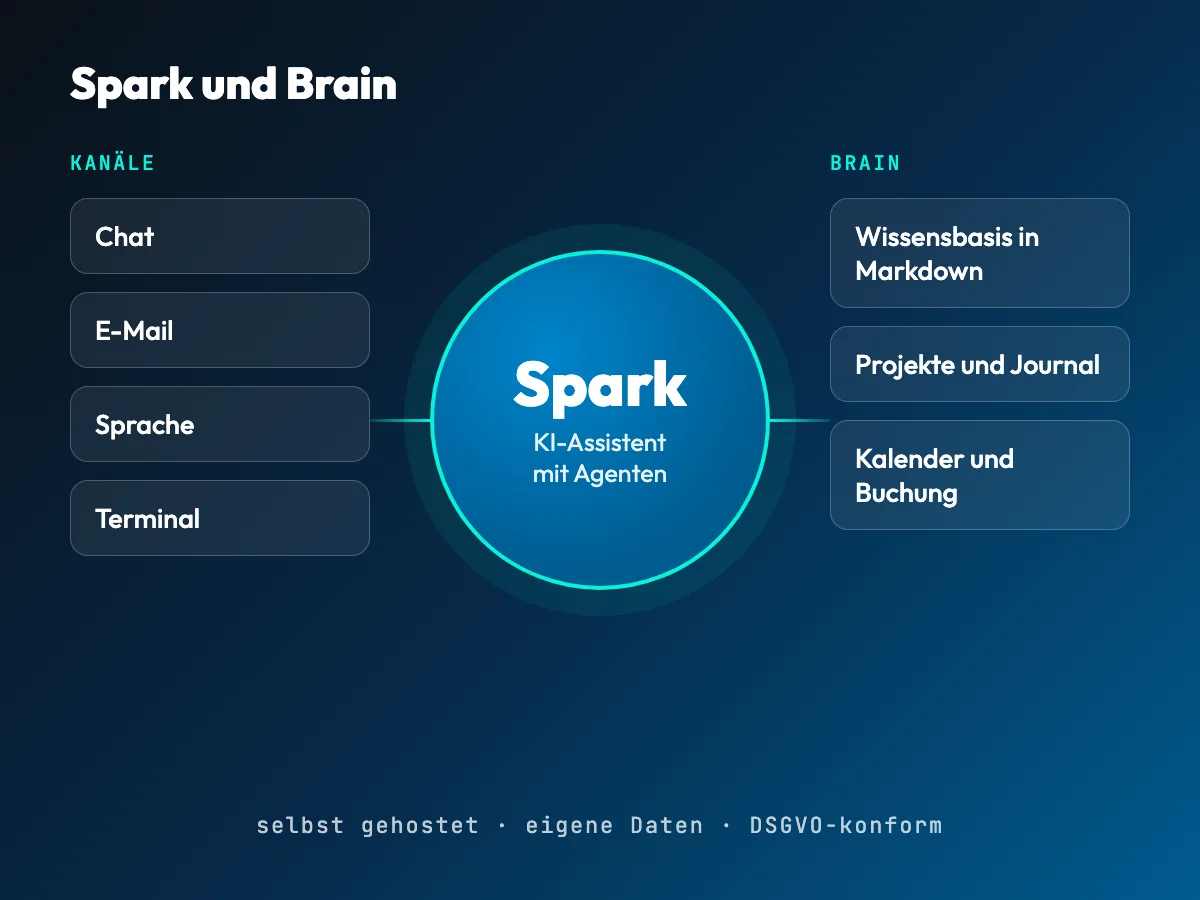
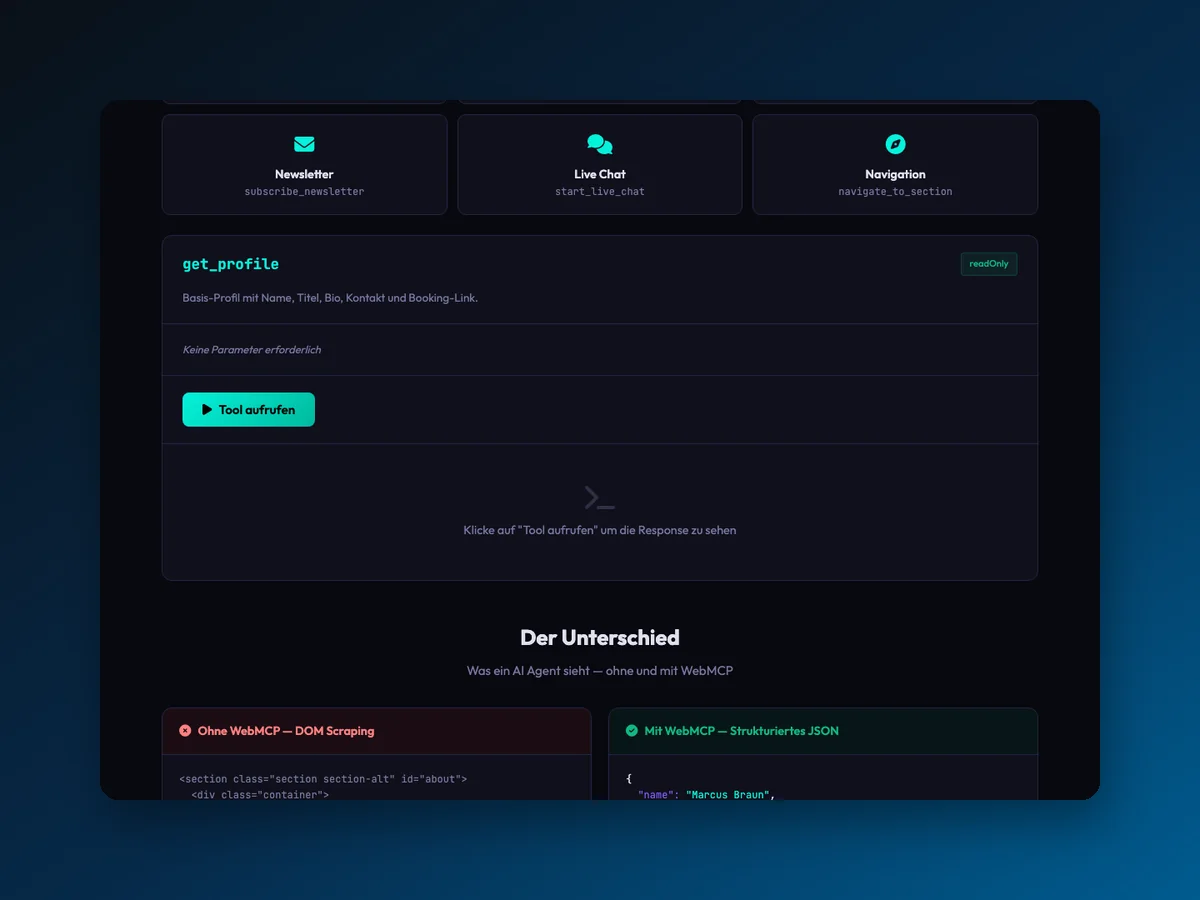
WebMCP is an approach that lets a website provide its content and functions as tools for AI agents. This website uses WebMCP, and you can try it out in the playground.
What is generative AI?
Generative AI creates new content such as text, images, code or speech. It is based on large models that have learned from a very large number of examples.
What is a large language model (LLM)?
An LLM is a language model trained on very large amounts of text. It can understand, summarise, translate and write texts. Well-known examples are Claude, GPT and Gemini.
What is an AI agent?
An AI agent is a language model that can use tools and work on a task independently in several steps, for example searching for information, editing files or entering appointments.
What is the Model Context Protocol (MCP)?
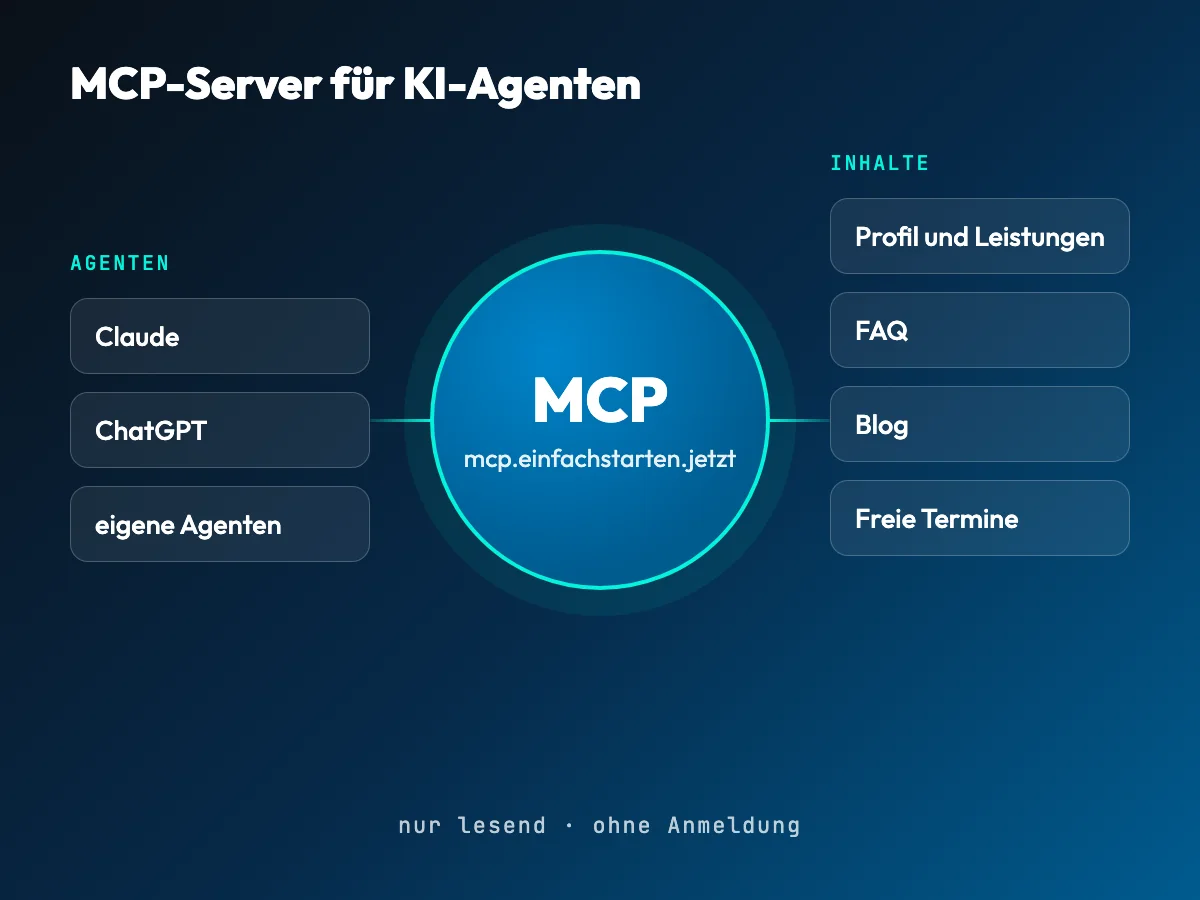
MCP is an open standard through which AI assistants access tools and data sources. This website offers a public MCP server.
What is prompt engineering?
Prompt engineering means phrasing requests to a language model in such a way that the results are reliable. Clear goals, context and examples are what matter.
What are hallucinations in AI?
Hallucinations occur when a language model produces statements that sound convincing but are false. Source references, verification steps and clear limits on use help against them.
What is the EU AI Act?
The AI Act is the EU regulation on artificial intelligence. It classifies AI systems by risk and lays down obligations for providers and deployers, including on the AI literacy of staff.
Where is the best place for a company to start with AI?
With recurring tasks that involve a lot of text or data and where errors are easy to spot. A small trial with a clear goal achieves more than a large programme.
What AI use cases are there in everyday office work?
Summarising and drafting texts, analysing documents and data, minutes, research, translations and support with software and automation.
How does AI help in project management?
With requirements, tickets, minutes, reports, analyses and prototypes. Responsibility for decisions remains with the project team.
Can AI be used in human resources?
Yes, for example for job advertisements, communication and knowledge management. Caution is needed when assessing applications, because models can select systematically wrongly. I demonstrate this in my talks with a live example.
How reliably do tools detect AI-generated text?
Not reliably. Such tools repeatedly flag texts as machine-written that were written by humans.
Does Marcus Braun offer AI workshops for companies?
Yes. The workshops are tailored to your needs, from an introduction for all staff to work on a team's concrete use cases.
What is rapid prototyping with AI?
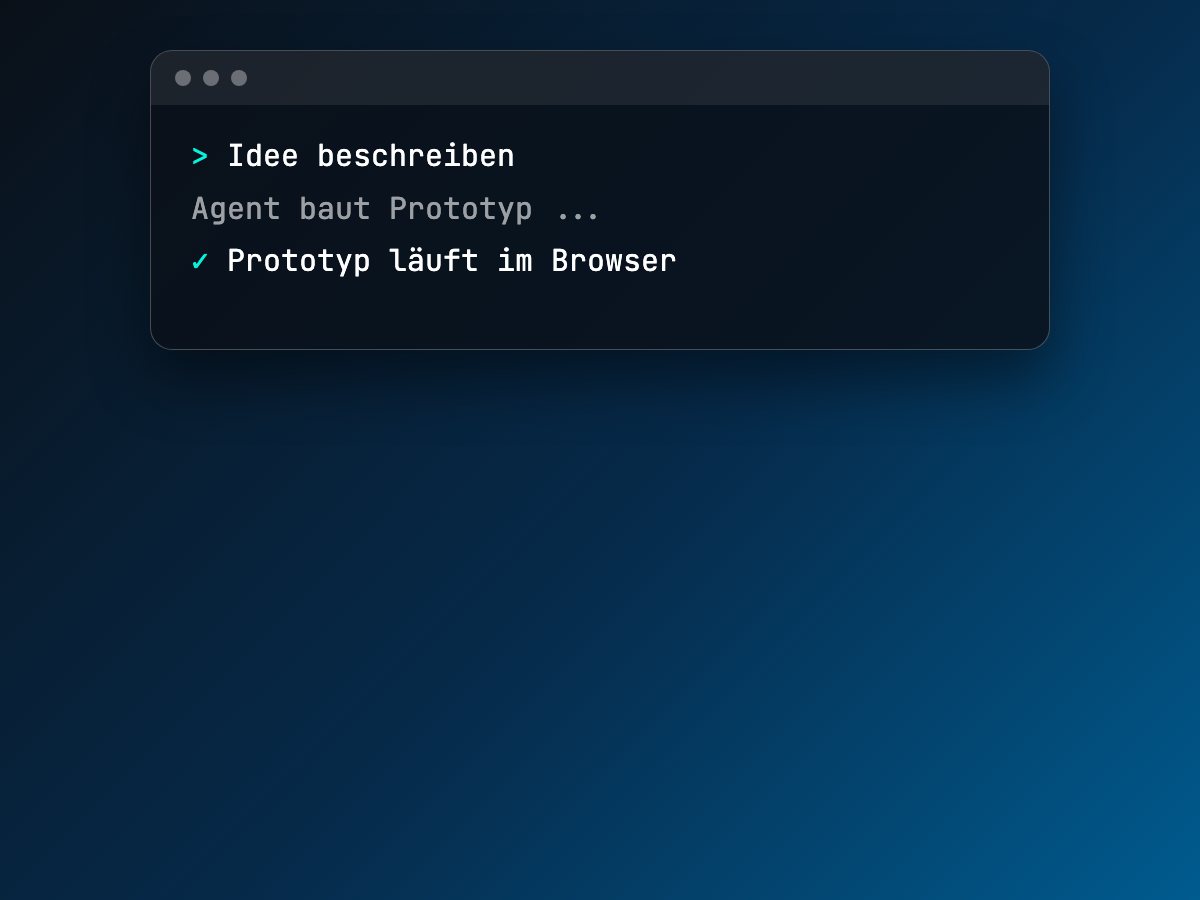
With AI support, an idea becomes a working prototype in a short time. This helps to make requirements tangible before a development team builds the product.
What data may I enter into AI tools?
That depends on the tool, the contract with the provider and the type of data. Personal and confidential data require clear rules within the company.
How do you stay up to date with AI?
By regularly trying things out yourself and by using reliable sources. In my blog I put developments into context, for example the annual Stanford AI Index.
Talks and workshops 14
Can Marcus Braun be booked as a speaker?
Yes. I give talks and workshops for companies, universities and educational institutions. You can send a request via the appointment booking or by email.
What topics does Marcus Braun speak about?
About artificial intelligence in the world of work and in day-to-day project work, about agile working, leadership and collaboration, and about connected cars and vehicle data. Other topics from my project work are possible on request.
How does a talk work?
In whatever way suits your occasion. Options include a classic talk with discussion, an interactive format where everyone joins in, or a workshop lasting several hours. I agree the duration, focus and depth with you in advance.
Who are the talks suitable for?
For managers, teams and specialist departments, for HR and executives, for customer events and conferences, and for students. I adapt content and language to the group's prior knowledge.
Where has Marcus Braun already spoken?
Among other places at Montanuniversität Leoben, where I have been giving guest lectures since 2023, twice in 2026 under the title “The Future of Work”.
In which languages are talks available?
In German and in English.
Does Marcus Braun also offer training courses?
Yes. I work in educational projects, as a guest lecturer at educational institutions and as a trainer for business partners, and I pass my knowledge on to teams and staff.
How long does a talk take?
Anything is possible, from a short keynote and 45 to 90 minutes up to a half-day or full-day workshop.
Are talks also possible online?
Yes, talks and workshops are possible on site and online.
How do I book a talk or workshop?
Via the appointment booking on this website or by email. In a short call we clarify topic, group, format and date.
Can a talk be tailored to our company?
Yes. I align examples, focus and depth with your industry and the participants' prior knowledge.
Are there talks for schools and young people?
Yes. I work in educational projects and also give talks and workshops for young people.
What is the difference between a workshop and a talk?
In a talk I convey content and answer questions. In a workshop the participants work out results themselves, while I prepare, facilitate and document.
Does Marcus Braun speak at conferences and customer events?
Yes, as a speaker on AI, agile collaboration and connected cars.
Project management, product owner, scrum master and requirements engineering 19
What roles does Marcus Braun take on in projects?
Project management, product owner, scrum master and requirements engineer. I have been working in agile management and as an active member of agile teams since 2008.
What certifications does Marcus Braun hold?
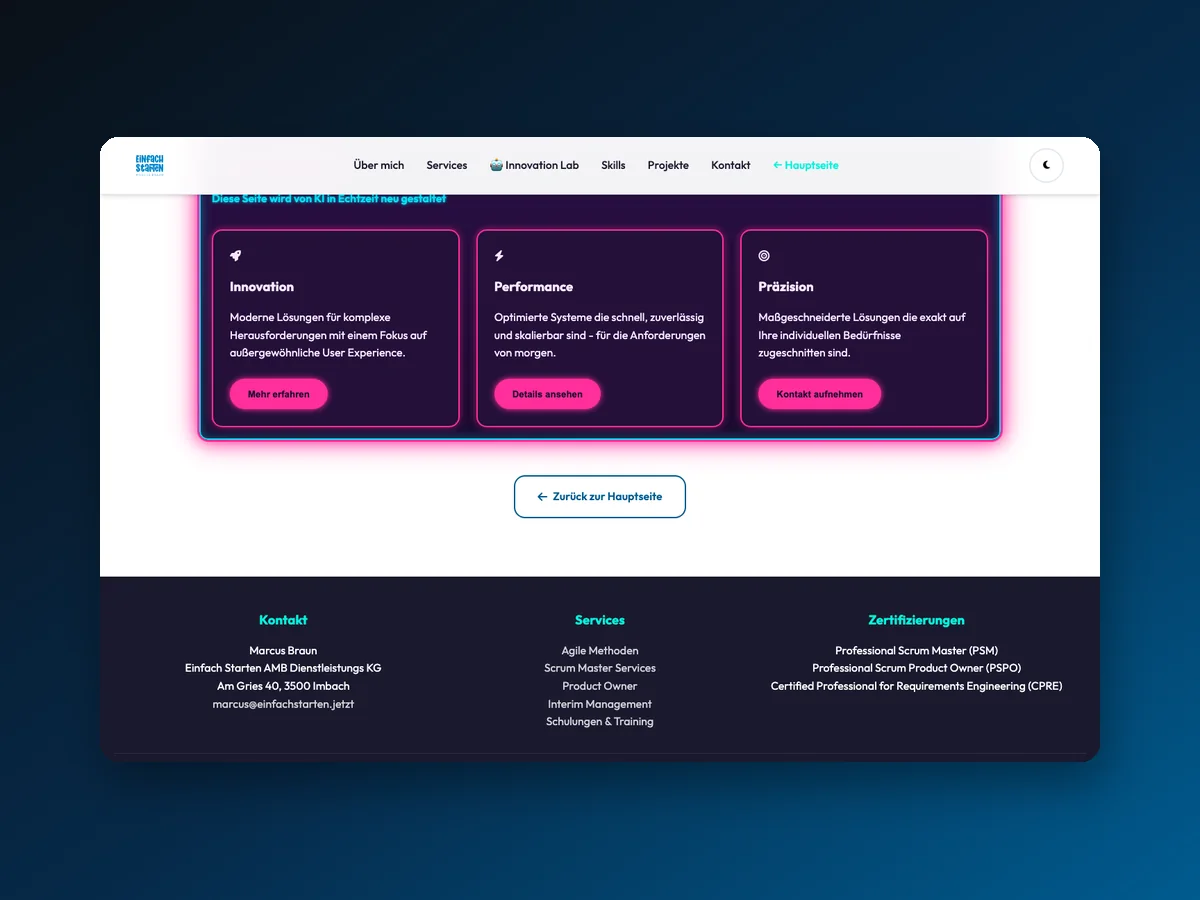
Professional Scrum Master (PSM), Professional Scrum Product Owner (PSPO) and Certified Professional for Requirements Engineering (CPRE).
What does a product owner do?
A product owner is responsible for what a product should deliver and prioritises the work of the development team. I take on this role to maximise the value of your product or project.
What does a scrum master do?
A scrum master makes sure a team can work according to Scrum and removes obstacles. I support Scrum teams in implementing agile processes efficiently.
What is requirements engineering?
Requirements engineering covers eliciting, specifying and managing requirements. I am IREB-certified and apply this knowledge to complex products.
In which industries has Marcus Braun worked?
Among others in mobility and for automobile clubs (ÖAMTC, ADAC) and in traffic technology, for example on the video detection system of Kapsch TrafficCom AG, whose relaunch won the Intertraffic Innovation Award.
What does “Business meets engineering” mean?
I work between business and engineering: I clarify requirements, lead projects and take products all the way into operation.
What is agile project management?
Agile project management works in short increments, delivers usable results early and continuously adapts the plan to new insights.
What is Scrum?
Scrum is a framework for agile product development. A team works in sprints of a few weeks, with the roles of product owner, scrum master and development team.
What is Kanban?
Kanban makes work visible on a board and limits how much is in progress at the same time. This reveals bottlenecks and shortens lead times.
What is the difference between a project manager and a product owner?
The project manager is responsible for schedule, budget and coordination. The product owner is responsible for the content and value of the product. In practice the two have to work closely together.
When does an agile approach make sense?
When requirements change, the result cannot be fully described at the start and early feedback helps. For fixed, well-known processes a classic approach may be a better fit.
What is a user story?
A user story describes a requirement from the user's point of view: who needs something, what and why.
What is a sprint review?
At the end of a sprint the team shows what has been completed and collects feedback from the stakeholders.
What is a backlog?
The backlog is the ordered list of all requirements for a product. The product owner prioritises it.
Can Marcus Braun take over a running project?
Yes. I also join projects that are already under way, get an overview and take on project management or the product owner role.
Does Marcus Braun support the introduction of agile methods?
Yes, with consulting, training and by accompanying teams in their daily work.
What does a project manager in IT do?
They plan and steer the project, align business, engineering and suppliers, keep an eye on risks and make sure the result goes into operation.
Does Marcus Braun also work with distributed and international teams?
Yes. I have worked with teams and partners in several countries, in German and English.
Leadership and collaboration 6
What is lateral leadership?
Lateral leadership means leading without formal authority, for example as a project manager, product owner or scrum master. It is based on trust, mutual understanding and shared goals.
What is servant leadership?
Servant leadership sees leadership as a service to the team: the leader creates the conditions in which others can do good work.
How do you lead a team without formal authority?
Through clear goals, reliable agreements, transparency and removing obstacles. Professional credibility and listening count for more than position.
Does Marcus Braun offer leadership seminars?
Yes, on lateral leadership, servant leadership and collaboration in agile teams.
How do you improve collaboration between business and IT?
By having both sides talk to each other early and regularly, clarify requirements together and show results often. This is exactly the interface I work at.
What are modern leadership styles?
Leadership styles that rely on trust, personal responsibility and collaboration rather than instruction and control.
Product development and innovation 7
What is an MVP?
MVP stands for minimum viable product: the smallest version of a product that delivers real value and real feedback.
What is a proof of concept?
A proof of concept shows with little effort whether an idea is technically and functionally feasible before more is invested.
What is design thinking?
Design thinking is a method for developing solutions starting from the needs of the users, with rapid experimentation and learning.
How do you get from an idea to a product?
Via a clear problem, a prototype, early feedback and a small pilot. After that it becomes clear whether and how to scale.
What is co-creation?
Co-creation means developing products together with customers and employees. At ÖAMTC FutureLab I led a pilot project on this.
Does Marcus Braun accompany products from idea to operation?
Yes. I clarify requirements, lead the implementation and accompany products into operation.
Has Marcus Braun received awards for projects?
Two projects under my lead have received awards: ÖAMTC Smart Connect won the FIA Innovation Award, and the video detection system of Kapsch TrafficCom AG won the Intertraffic Innovation Award.
Interim management and strategy 9
What is interim management?
Interim management is leadership for a limited time. I offer flexible support in leadership positions, to bridge gaps, accompany change processes or lead special projects.
When does an interim manager make sense?
When a leadership role is vacant at short notice, a project needs help getting started, or experience is missing for a limited time that is not available in the company.
What is a strategy workshop?
In a tailor-made workshop we work out a strategy for your product, project or company together, so that everyone knows which goal they are working towards.
Who prepares and documents a workshop?
I take care of preparation, facilitation and documentation, tailored to the needs of your company or team.
Does Marcus Braun have experience with innovation projects?
Yes. At ÖAMTC FutureLab I led a pilot project to develop a co-creation platform.
How quickly can an interim manager start?
That depends on my availability. In a first call we clarify the task, scope and possible start.
How long does an interim assignment last?
Typically a few months up to about a year, depending on the task.
What is the difference between a consultant and an interim manager?
A consultant recommends. An interim manager takes on responsibility within the organisation for a limited time.
What does a strategy workshop achieve?
A shared picture of goal, priorities and next steps that everyone involved supports.
Working together 15
Who is Marcus Braun?
I have been in IT since 2001 and self-employed with Einfach Starten AMB Dienstleistungs KG since 2020. My focus areas are connected car platforms, artificial intelligence in practice and agile management.
Where is Einfach Starten based?
In Imbach near Krems an der Donau in Lower Austria. I work for clients in Austria and Germany, on site and remotely.
How can I make an appointment?
Via the appointment booking on this website. You choose a duration of 30 or 60 minutes and an available slot and receive a confirmation by email.
What does working together cost?
That depends on the task and scope. You will receive a quote after a first call.
In which languages does Marcus Braun work?
In German and English.
How does this website handle my data?
Appointment booking runs on our own, self-operated system. Analytics and live chat are only loaded after you have given your consent. Details can be found in the privacy policy.
Is there a newsletter or a blog?
Both. My posts on AI, connected cars and projects appear in the blog (in German), and you can sign up for the newsletter on the home page.
How can AI agents retrieve information about Marcus Braun?
Via the llms.txt file, the WebMCP tools of this website and a public MCP server. The access routes are described on the page “For AI agents”.
Does Marcus Braun work remotely or on site?
Both. Many projects run mostly remotely, with on-site meetings where it makes sense.
Which companies does Marcus Braun work for?
For corporations, medium-sized companies, associations and educational institutions, directly or through partner companies.
How does a first call work?
You book 30 or 60 minutes. We talk about your project and clarify whether and how I can help.
Is the first call non-binding?
Yes.
How can I reach Marcus Braun?
By email at [email protected], via the appointment booking on this website or via LinkedIn.
What does “Einfach Starten” mean?
It is German for “simply start”. The name stands for my approach: begin with a manageable first step instead of planning for a long time.
How long has Einfach Starten existed?
Einfach Starten AMB Dienstleistungs KG has existed since 2020.